
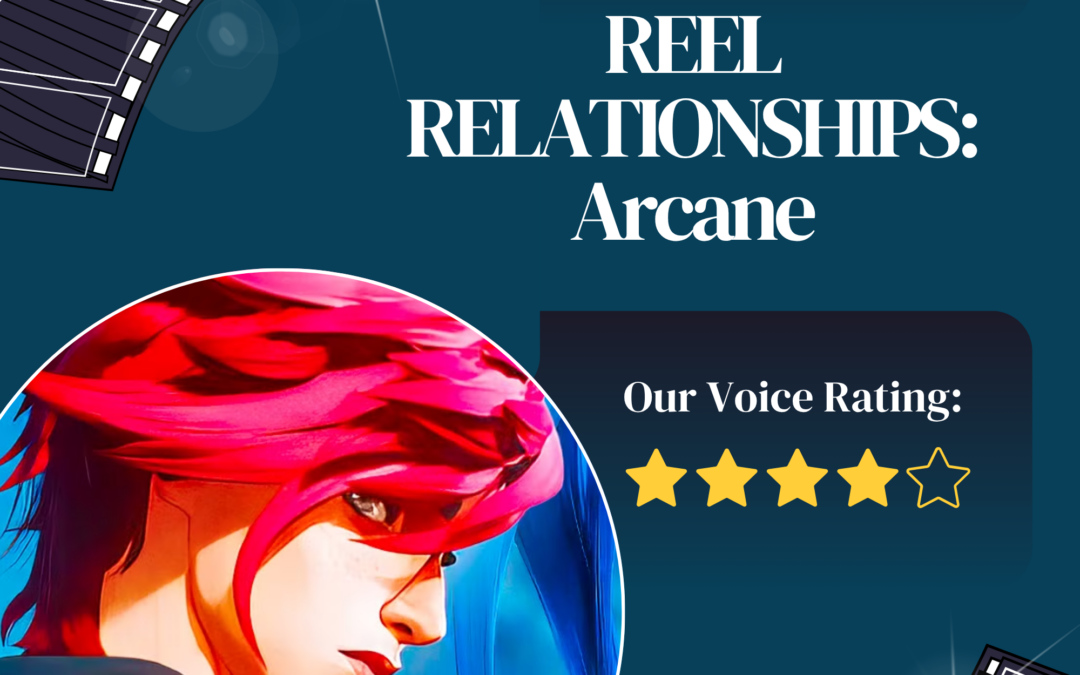
Arcane is Netflix’s animated series set in the world of League of Legends, following the cities of Piltover and Zaun as they fracture along lines of class, power, and unhealed trauma. The show has been widely praised for its emotional depth and complex characters, and it well earns that praise. This month, we are looking at it through a trauma-informed lens, exploring what it shows us about power and control, trauma, consent, and healthy relationship dynamics.
Note: This blog contains spoilers for both seasons of Arcane.
Our Rating: 4 out of 5 stars
Arcane portrays the emotional reality of trauma and unhealthy relationship dynamics with remarkable honesty and complexity. It earns high marks for treating its characters with dignity and showing the real consequences of coercion and control. There is room to grow around explicit modeling of consent and healthy communication, but the show gives viewers a lot of meaningful material to think and talk about.
Trauma and Relationships
One of the most important things Arcane does is treat trauma as an ongoing force rather than a backstory. It lives in the body, shapes decision-making, and ripples through every relationship the characters have.
Vi channels her losses into physical intensity and a desperate need for stability. Jinx’s unprocessed abandonment shows up as fragmented thinking and an identity built almost entirely around pain. Jayce and Viktor’s deep partnership fractures partly because grief pulls them in incompatible directions. The show understands that people do not simply move on from trauma, and that honest portrayal matters. From a trauma-informed perspective, this is one of Arcane‘s greatest strengths.
Importantly, the show also treats its characters with dignity throughout. Even in their worst moments, they are shown as full human beings shaped by circumstance rather than simply broken or evil. Powder does not become Jinx because she is bad. She becomes Jinx because she was abandoned, exploited, and never given the safety she needed to heal. This reflects a core belief at Our Voice: that people’s choices make sense in the context of what they have experienced.
Power and Control
Power and control show up throughout Arcane in ways that feel true to life, particularly in caregiving and family relationships.
Silco’s relationship with Jinx is one of the most nuanced depictions of a coercive caregiving dynamic in recent media. He takes Powder in when she is at her most vulnerable, shapes her identity around his needs, and praises her most destructive tendencies rather than helping her heal. Over time, his affection for her appears genuine, and that complexity is important to name. Coercive relationships in real life often contain real care alongside real harm. Showing both truths at once, without letting one cancel the other out, is something Arcane handles with real skill.
Ambessa and Mel offer a similarly honest look at how control within families can be wrapped in love. Ambessa offers Mel belonging and acceptance as leverage, conditional on her compliance. Mel’s journey toward independence, choosing her own values over her mother’s demands, is a compelling portrayal of what it looks like to reclaim agency from a controlling relationship. It is not clean or linear, and the show does not pretend it is.
Consent and Boundaries
Consent is an area where Arcane is more implicit than explicit, though there are meaningful moments worth highlighting.
Vi and Caitlyn’s relationship is the clearest example of two people genuinely trying to navigate boundaries with each other. They communicate honestly, even when it is painful. When they disagree about something fundamental, they say so directly rather than manipulating or withdrawing. When they eventually part in Season 2, it is because Vi holds a boundary around her values that she is not willing to compromise, even for someone she loves.
It is also worth pausing on a dynamic that the show raises but does not fully name: Caitlyn is a law enforcement officer, and Vi is a woman from Zaun with a criminal record who spent years in prison. That is not a neutral backdrop for a romantic relationship. Power does not disappear because two people have feelings for each other, and in relationships where one person holds institutional authority over the other’s community, that imbalance shapes everything, including what feels safe to say, what feels possible to ask for, and whose needs tend to get centered. Vi navigating a romance with someone who has the power to arrest, surveil, or otherwise affect the lives of people she loves is a real dynamic that many people experience in their own lives. The show gestures at this tension, particularly as Caitlyn rises in rank, but it largely leaves it to the audience to sit with. That is a conversation worth having out loud.
The show is less explicit about consent as an ongoing practice of communication, which is a place where viewers may benefit from additional context. Watching Arcane alongside conversations about what consent actually looks like in practice makes the viewing experience richer and more useful.
Healthy vs. Unhealthy Dynamics
Arcane gives us the full spectrum of relationship dynamics, and it does not always make it easy to tell them apart at first glance, which mirrors real life.
Jayce and Viktor’s partnership, at its best, is one of the healthiest relationships in the show. They come from different backgrounds and classes, but they build something together through mutual respect and a genuine belief in each other. Their fracture in Season 2 does not erase that foundation. It demonstrates how even strong relationships can be tested when people are in pain and pulling in different directions.
Vi and Caitlyn, for all the difficulty of their circumstances, also model some genuinely healthy communication. They check in with each other, express vulnerability, and engage in honest conflict without contempt. The tension of their relationship, a Zaunite woman and a Piltover enforcer, is never fully resolved, and the show does not pretend otherwise. Acknowledging real power imbalances rather than papering over them is itself a form of honesty.
Conclusion
Arcane is absolutely worth watching and worth talking about. Its portrayal of how trauma, power, and circumstance shape the way people connect with and sometimes harm each other is sophisticated and, at times, genuinely moving. It invites viewers to think critically about the relationships they see on screen, which is exactly what this series is designed to do.
If any of the themes in this blog resonate with your own experiences, Our Voice is here. We offer free, confidential counseling and advocacy to survivors of sexual violence and trafficking in Buncombe County, and we believe that healing is possible. Reach our 24/7 crisis line at (828) 255-7576 or visit ourvoicenc.org to learn more.