
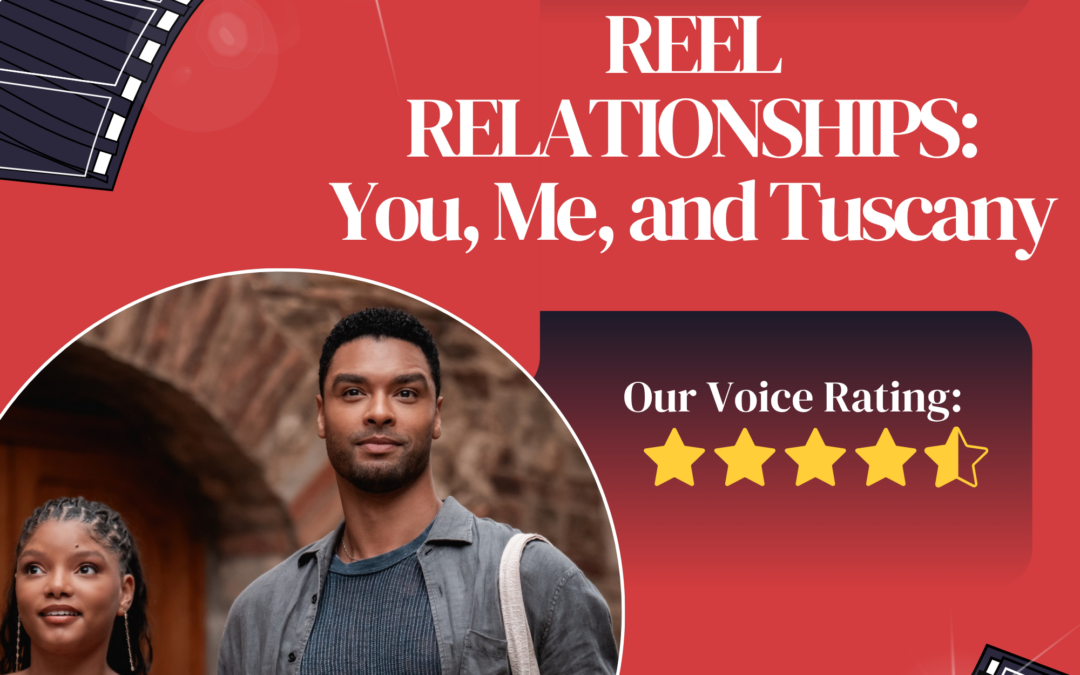
A lot of us love a feel-good story. We love sitting in theaters and gushing over a cute romance to escape from daily life.
You, Me, and Tuscany is one of those films. Released in theaters this month, the movie centers Black love in a charming Italian setting. It follows Anna, a young woman who has been professionally house-sitting and is searching for her next step. She meets Matteo, an Italian man traveling for work, who encourages her to take the trip to Italy she never went on after losing her mom. After their night together, Anna decides to go, embarking on a story of love, lies, and Italian wine.
The following may contain spoilers, read at your own risk. Or don’t, and let this blog inspire you to see this adorable movie.
Consent and Boundaries
One of the first themes we have to point out is consent and boundaries. This appears almost immediately when Anna goes through Matteo’s phone while he is asleep.
When they meet at the bar, there is clear flirtation and the potential for them to spend the night together. Matteo invites Anna back to his hotel room, but after getting ready in the bathroom, she returns to find him asleep.
She then takes his phone and looks through his photos. While this may seem harmless at first glance, especially since she is looking at photos they took together and sending them to herself, it is still a breach of privacy. She should not be going through his phone without permission.
Another example appears when Anna travels to Italy. Following Matteo’s advice, she decides to use the plane ticket her mom bought before she passed. The problem is that she has nowhere to stay.
When she arrives, she learns that a popular summer festival has filled every hotel. With no options left, she remembers Matteo mentioning that his house is vacant and uses the photo she airdropped to locate it.
She breaks into his home and creates a complicated situation by lying to his family, claiming that she and Matteo are engaged. This happens entirely without his knowledge and is clearly problematic.
When confronted, Anna claims Matteo “practically invited her” by telling her about the villa and showing her pictures. This highlights unclear consent. Anna should have clarified his intent instead of assuming she had permission to stay there.
Though it makes for a cute story, she should not have stayed in his home without permission, and she definitely should not have lied about their engagement.
Grief and Moving On
Both main characters, Anna and Michael, share experiences of grief, having lost their parents. While they are at different stages in their journeys, they bond over these losses and begin to move forward in their own ways.
Anna lost her mother recently, which upended her life. She dropped out of culinary school, began working odd jobs, made poor financial decisions, and stopped cooking despite her passion for it.
Her trip to Italy begins to reopen that part of her, though she struggles at first. Toward the end of the film, she starts cooking again alongside Michael and Matteo’s family. She admits that cooking is difficult because it reminds her of her mom, making the experience emotional.
Michael shares a different perspective. He was younger when he lost his parents and was adopted by Matteo’s family. He explains that his loss grounded him and that he finds peace in continuing his parents’ work at the family vineyard.
Though their experiences differ, both characters begin moving forward. Anna returns to cooking, and Michael becomes more open. This reflects how grief can shape both our lives and our relationships.
Family Relationships
Family plays a central role in You, Me, and Tuscany, highlighting both strained relationships and the beauty of chosen family.
Matteo and Michael are quickly shown to have a strained relationship, partly due to Matteo leaving the family to travel. There are also hints of long-standing competition and unequal treatment.
This tension comes to a head during an argument, where Michael criticizes Matteo for leaving, and Matteo retaliates by saying Michael is seen as perfect despite “not being a real member of the family.”
These unresolved feelings show how conflict can build over time when not addressed. While they eventually reconcile, the film illustrates the importance of communication.
Matteo’s relationship with his father, Vincenzo, is similarly strained. Vincenzo hoped Matteo would take over the family restaurant, while Matteo felt pressured and chose to leave instead.
Rather than discussing their differences, they stopped speaking for about a year. Anna’s false engagement temporarily repairs their relationship by bringing Matteo back into the family space.
Although Matteo initially wants Anna to tell the truth, he continues the lie after seeing its positive effect on his relationship with his father. Eventually, Anna reveals the truth, upsetting Matteo. However, Vincenzo already suspects the relationship is not genuine, especially after noticing the chemistry between Anna and Michael.
In the end, things work out. Anna takes over as chef at the family restaurant, Matteo steps away from the business without guilt, and his relationship with his father improves.
The film also strongly emphasizes chosen family. Anna is quickly welcomed into Matteo’s family and treated as one of their own. This is especially clear when Gabriella tells Anna that she now has a family.
This theme continues throughout the film, with Anna ultimately finding belonging with the family and pursuing a relationship with Michael.
Michael’s story also reflects chosen family, as Matteo’s family took him in after his parents died. Vincenzo even affirms this in a heartfelt moment, telling Michael he is just as much his son as Matteo.
Overall, the film highlights how family, whether biological or chosen, provides support and connection.
Social Norms
Another theme worth noting is social norms. While smaller in scope, it still plays a role in how the story is presented.
The film includes moments that touch on cheating culture. Francesca, the sister, openly jokes about cheating on her husband with her plumber. While played for humor, it raises questions about how media can normalize infidelity.
Similarly, Matteo “cheats” on Anna, though their relationship is not official. The family believes they are engaged, creating a gray area. Still, Matteo does not try to hide his actions and justifies them by describing his relationship with his ex, Isabella, as complicated.
While these moments are not central to the plot, they are worth acknowledging as part of a broader conversation about what media portrays as acceptable.
As always, Reel Relationships is here to help us think more critically about the media we consume, not to take away from our enjoyment. This movie is fun, heartfelt, and absolutely worth watching.
This is especially important as You, Me, and Tuscany is one of the few films centered on Black love released in theaters in recent years. Representation like this matters, and these stories are often scrutinized more heavily than others. They deserve the same space to simply be joyful, romantic, and entertaining.
We hope to see more stories like this in the future.
We hope you enjoyed this installment of Reel Relationships. Join us next time as we discuss Euphoria Season 3. Be sure to check out our other articles and podcast episodes in the Listen and Learn tab.

Howie Cable is an intern at Our Voice and a local student. He loves to promote community health education through creative ways, such as this blog.